
Schulte Tables for Children: An Online Attention Trainer
The Schulte table is a short visual-search and attention exercise. Below, we explain how to use it at home and invite you to try the online trainer.
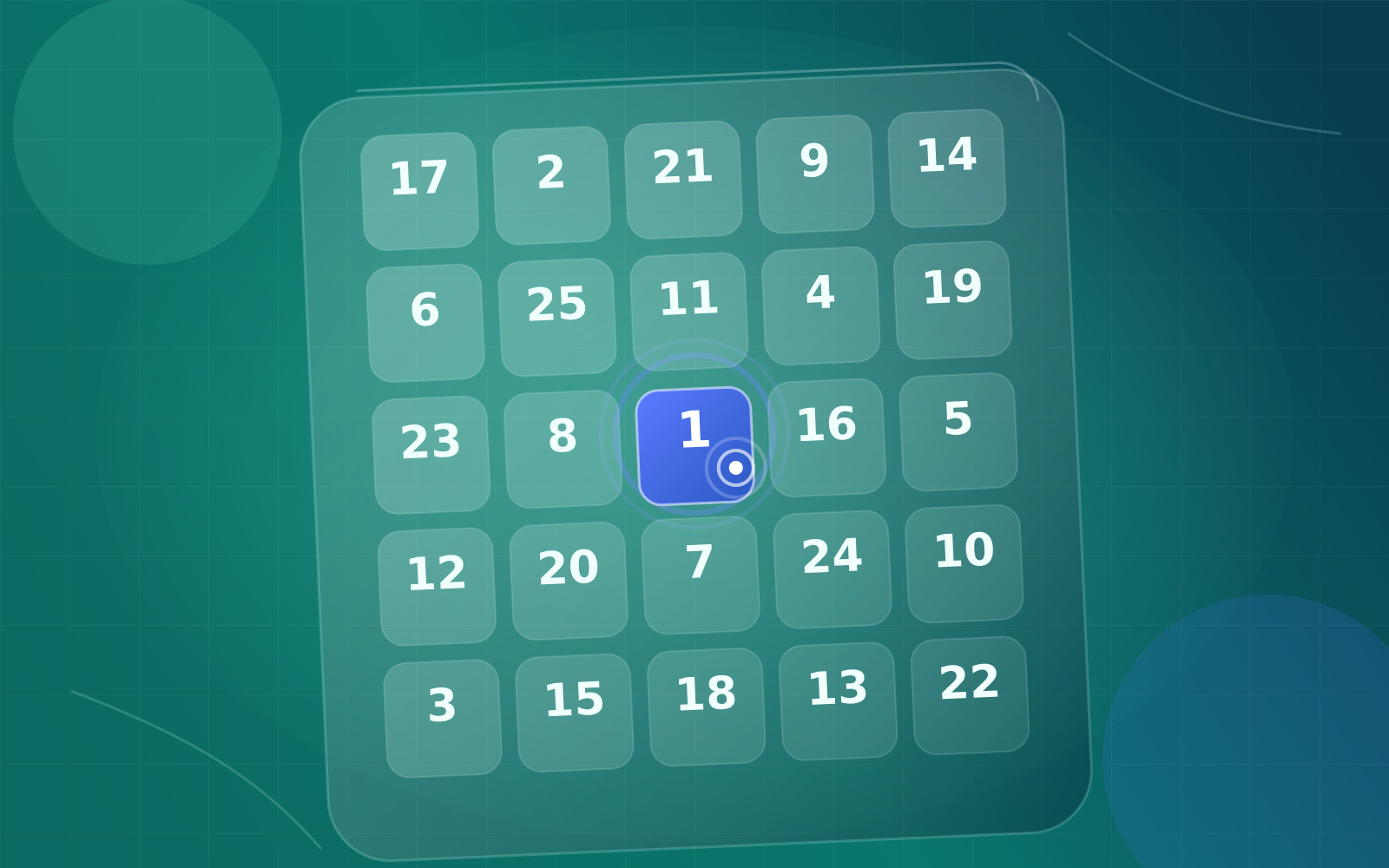
A child sees a grid of numbers arranged in random order and must find them in sequence: 1, 2, 3, and so on.
The task looks simple, but completing it requires the child to remember the rule, ignore neighboring numbers, scan the entire grid quickly, and respond accurately. This is why Schulte tables are used by teachers, psychologists, and reading specialists.
You can launch the online trainer below and try the exercise right now.
Find all the numbers in ascending order. Try to work quickly, but not so fast that you make mistakes.
What Is a Schulte Table?
A classic Schulte table is a 5 × 5 grid containing the numbers 1 through 25 in random positions. The task is to find and select them in ascending order as quickly as possible.
The method was originally developed as a psychodiagnostic task for assessing attention and cognitive performance. In a professional assessment, a specialist administers several tables and records completion time, errors, and changes in performance from one attempt to the next. This makes it possible to evaluate not only working speed, but also the initial adjustment to the task, sustained attention, and signs of fatigue.
In educational settings, the table is also used as a practice activity. For children, the task can be simplified by reducing the grid size, using a familiar number range, or replacing numbers with letters.
What Skills Do Schulte Tables Train?
The exercise engages several cognitive processes at the same time.
Visual Search
The child learns to find a target quickly among many similar items. This process is known as visual search. It is used constantly in learning—for example, when finding a letter in a word, a number in a calculation, a line in a text, or a particular piece of information on a page.
Selective Attention
Selective attention helps the child focus on a relevant signal without being distracted by competing information. The child searches for one specific number while seeing all the others at the same time.
Sustained Attention
Completing the table requires the child to maintain the goal and follow the sequence for several minutes. After finding each number, the child keeps the rule in mind and applies it again to the next target.
Visual Processing Speed
With practice, the child may recognize the target symbol and make a decision more quickly. Speed should always be considered together with accuracy: finishing quickly by making many random taps is not a good result.
Cognitive Control and Attention Shifting
After finding one number, the child must stop searching for it and move on to the next. This repeated change of target requires voluntary control of attention.
Do Schulte Tables Help Children Read Faster?
Schulte tables are often used in speed-reading classes. The exercise does involve skills that support reading, including visual search, concentration, and the rapid perception of symbols.
When the child tries to take in the grid as a whole and begins searching from its central area, they also practice processing a wider span of visual information. Educational literature often describes this as training peripheral visual perception. A similar task that trains a wider span across a line is the wedge table.
However, Schulte tables do not teach a child to read on their own. They do not build reading comprehension, vocabulary, letter-to-syllable blending, or the ability to make sense of a text. They are best treated as a supplementary exercise, not as a replacement for a complete reading program.
At What Age Can a Child Start?
The classic 5 × 5 task is generally used from around age 6 or 7, once a child confidently recognizes the numbers up to 25 and understands the instructions.
For preschoolers, you can use simplified versions:
- 3 × 3: numbers 1 through 9;
- 4 × 4: numbers 1 through 16;
- tables containing letters the child already knows;
- a relaxed mode with no pressure to set a record.
Choose the grid size based not only on the child’s age, but also on their current skill level. If the grid is too difficult, the exercise turns into guessing and quickly becomes frustrating. It is better to start with a level the child can complete independently.
How to Do the Exercise Correctly
- Place the device directly in front of the child. The entire table should fit clearly on the screen.
- Give a brief instruction: “Find all the numbers in order, starting with 1.”
- First, ask the child to look at the central area of the table and try to take in the whole grid.
- Do not point to the correct numbers or indicate where the child should look.
- Track the number of errors as well as the completion time.
- When the child finishes, praise their accuracy and independence, not only their speed.
Do not expect the child to keep their eyes completely still. This is difficult for a beginner and creates unnecessary tension. At first, correct sequencing and calm, systematic searching matter most. More efficient eye movements develop gradually.
How Long Should a Practice Session Last?
A few minutes is enough for one practice session. The child can complete one or several tables for as long as they remain attentive and interested.
It is better to finish early than to continue once the child is tired. If the child starts tapping at random, loses track of the sequence, or becomes frustrated, stop the session or switch to an easier grid.
Regular short practice is more useful than occasional long sessions. A Schulte table can be included in a five-minute daily attention routine or used several times a week alongside other activities.
How to Evaluate Your Child’s Results
An online trainer makes it easy to track three measures:
- completion time;
- number of errors;
- consistency across several attempts.
It is better to compare the child with their own previous results. Completion speed is strongly affected by age, grid size, the device being used, familiarity with the task, and how the child feels at that moment.
One attempt is not enough to draw conclusions about a child’s attention, let alone make a diagnosis. For a professional assessment, a psychologist uses a standardized procedure, several tables, and age-based norms.
Common Mistakes Parents Make
Starting with a 5 × 5 Table
If the child still recognizes numbers slowly, start with a 3 × 3 grid. Increase the difficulty only after they can complete the easier version without help.
Focusing Only on Setting a Record
Too much pressure reduces the quality of performance. The goal is an organized visual search, not a burst of fast, random taps.
Giving Hints with Your Eyes or Finger
In this case, the adult is doing part of the work. The child needs to plan the search and maintain the sequence independently.
Using the Same Table Every Time
The positions of the numbers should change. Otherwise, the child gradually memorizes their locations, and the exercise no longer provides genuine visual-search practice.
Using Schulte Tables Instead of Reading Practice
The trainer can supplement lessons, but developing reading skills still requires work with sounds and letters, practice reading syllables, words, and texts, and activities that build reading comprehension.
How Educators Can Use Schulte Tables
A Schulte table works well as a brief warm-up at the start of a lesson, a transition between demanding activities, or an individual practice task. Educators can adjust the grid size and content to suit each learner’s level. To practice suppressing an automatic response, you can add the Stroop test.
In group settings, it is important not to turn the exercise into a competition between children. Some children scan the visual field more quickly, while others need more time to recognize numbers. It is more useful to track each learner’s individual progress.
Try a Schulte Table Online
Launch the trainer again and invite your child to complete a new grid. The numbers will appear in different positions, so the child will have to perform a genuine visual search rather than repeat a memorized route.
In LARNES, Schulte tables are part of a system of short educational activities. Children practice for just a few minutes, while the tasks gradually change and complement one another across attention, memory, logic, reading, and mathematics.
Find all the numbers in ascending order. Try to work quickly, but not so fast that you make mistakes.
For parents: get short, meaningful activities for your child every day.
For educators: use LARNES trainers in your lessons and share them with your students.
Use the Schulte Table trainer and more than 50 other trainers to support your child's learning or your students' progress.
Sign upFrequently asked questions
Do Schulte tables improve memory?
The classic exercise primarily trains visual search, attention, and processing speed. The child also has to keep track of the current target—the number they need to find next. However, Schulte tables should not be presented as a stand-alone tool for training every type of memory.
Does the child need to say the numbers aloud?
For online practice, it is enough to tap the numbers in order. Saying them aloud adds a verbal task and may slow the child down. If the child is still learning the numbers, an adult can ask them to name each one, but that makes it a slightly different exercise.
Can my child practice on a phone?
Yes. A phone works well for a short attention exercise as long as the entire table is clearly visible, the numbers are large enough, and the child is not making mistakes because the buttons are too small. A tablet or computer is more convenient for larger grids.
How is a letter table different from a number table?
The principle is the same: the child searches for familiar symbols in a given sequence. A letter-based version adds practice in recognizing letters quickly, but it does not replace learning letter sounds or blending letters into syllables.
Can the result be used to assess my child’s attention?
The online trainer shows how the child performed on one particular attempt. That is not enough for a psychological assessment: a specialist uses several tables, gives standardized instructions, refers to age-based norms, and analyzes how performance changes across attempts.
Sources and Further Reading
- Sergienko A. A., Zvereva N. V., et al. “Using the Schulte Tables with Children and Adolescents: New Approaches to Analysis and Norms,” 2024. A study of 239 children and adolescents aged 7–17.
- Khramova M. V. et al. “Monitoring the Cortical Activity of Children and Adults during Cognitive Task Completion,” Sensors, 2021. DOI: 10.3390/s21186021.
- Karimulina E. G., Khlyustova N. G. “Attention Orientation in Children with ASD,” Autism and Developmental Disorders, 2020. Describes the use of Schulte tables to assess neurodynamic processes and the efficiency of attention shifting.
- Shigina I. A. “Schulte Tables in Primary School as a Tool for Developing Speed-Reading Skills,” Modern Primary School, 2021, No. 28.