
Stroop test for children: an online attention exercise
In the Stroop test, you name the color of the letters while trying not to read the word. Below, we explain how to use it at home and invite you to try the online trainer.
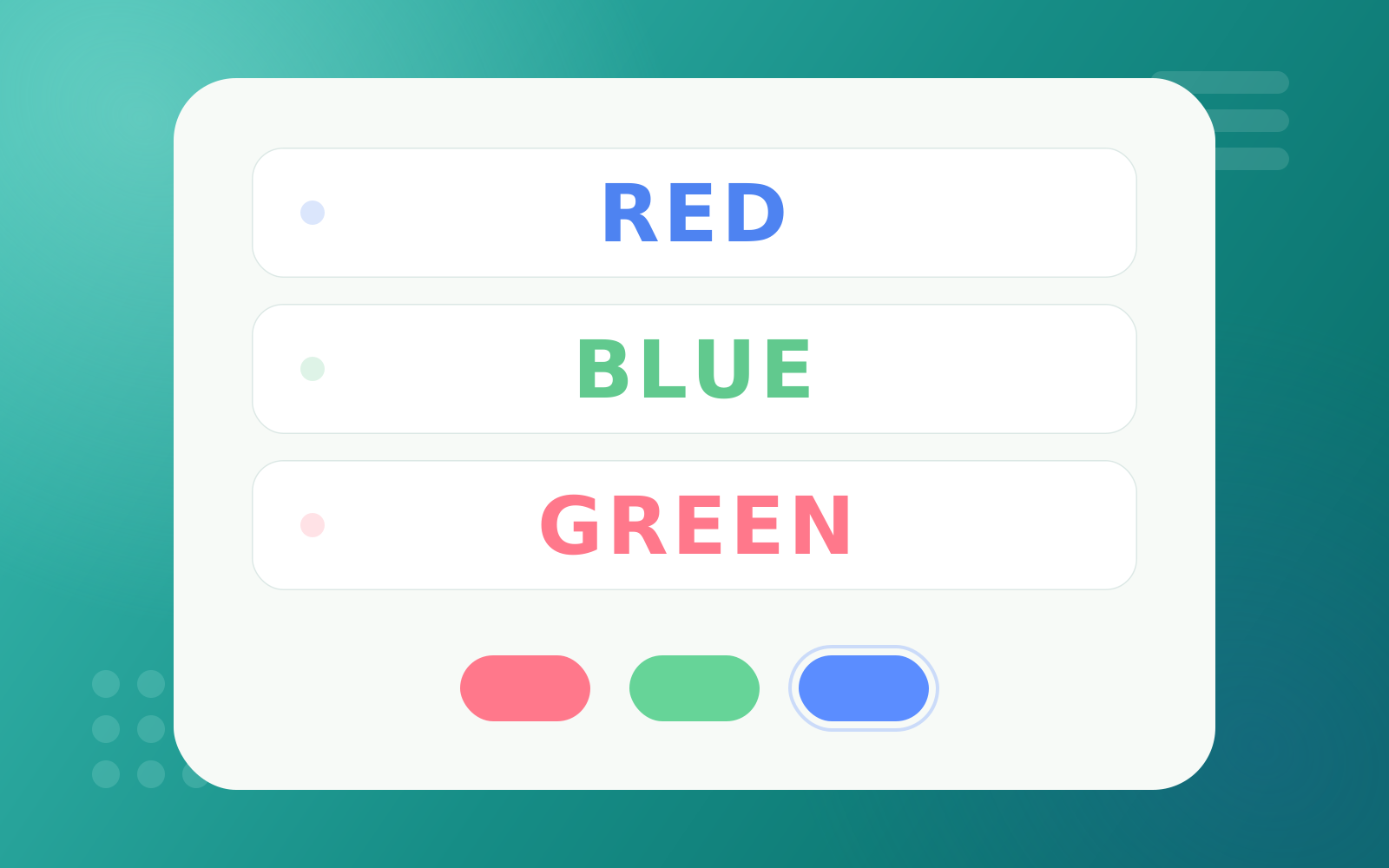
Imagine that the word “RED” is written in blue letters. What do you notice first: the meaning of the word or its actual color?
The task looks simple, but the habit of reading activates almost automatically and interferes with the new rule. This creates cognitive interference: a conflict between two signals processed at the same time.
You can launch the online trainer below and experience this effect for yourself.
Look at the color of the letters, not the meaning of the word. If the word “YELLOW” is written in green, the correct answer is “green.”
What Is the Stroop Test?
The Stroop test is one of the best-known experimental tasks in cognitive psychology. Its classic version was described by American psychologist John Ridley Stroop in 1935.
Participants are shown color names printed in colored letters. Sometimes the meaning of the word matches the color: for example, “BLUE” is written in blue. This is a congruent stimulus: the information is consistent.
In other cases, the word and the color conflict: “BLUE” is written in red. This is an incongruent stimulus. To give the correct answer, “red,” a person must suppress the automatic tendency to read the word and direct their attention to the color of the letters.
People generally respond more slowly and make more errors when presented with incongruent stimuli. This difference is known as the Stroop effect.
Why Is It Difficult for the Brain to Ignore the Word?
When children are first learning to read, they have to consciously recognize each letter and combine the letters into a word. As reading skills develop, familiar-word recognition becomes automatic: the brain retrieves a word’s meaning quickly and without a deliberate command.
Identifying colors is also familiar to a child, but in the Stroop test it competes with a well-established response: reading the word. The child has to stop the first impulse and perform the less habitual action.
This process involves suppressing cognitive interference. It is part of inhibitory control: the ability to withhold an automatic or inappropriate response in order to pursue a current goal.
What Skills Does the Stroop Test Engage?
Selective Attention
The child must focus on one feature of the stimulus (the color of the letters) and temporarily ignore another feature, the meaning of the word. This ability to select relevant information is known as selective attention.
Inhibitory Control
Inhibitory control helps stop the first automatic response. In this exercise, the child refrains from reading the word aloud and answers according to its color.
Interference Control
Interference occurs when one piece of information disrupts the processing of another. The child learns to notice this conflict and follow the instruction despite the distraction.
Processing Speed
To respond, the child has to recognize the color, match it to the available options, and select the correct answer. This is why both accuracy and reaction time are considered when evaluating performance.
Voluntary Self-Regulation
The child keeps the rule in mind, monitors the response, and corrects an error after answering too quickly. These processes are part of executive functions: the skills that help us act according to a goal rather than simply follow the first impulse.
Is the Stroop Test an Assessment or a Trainer?
In scientific and clinical practice, the Stroop test is used as one component of a neuropsychological assessment. A specialist compares performance across several conditions: reading words, naming ordinary color stimuli, and responding to conflicting color words. Completion speed, errors, and the differences between conditions are all taken into account.
On an educational platform, it is a short exercise for attention and interference control. The child experiences a cognitive conflict, practices keeping the rule in mind, and tries to respond more accurately.
The online trainer does not replace a professional assessment. If a child completes one attempt slowly or makes many errors, this does not by itself indicate an attention disorder.
At What Age Is the Stroop Test Appropriate?
The classic color-word version is meaningful when a child:
- can confidently distinguish all the colors used in the task;
- can read the names of those colors;
- understands the instruction and can keep it in mind throughout the task.
These abilities generally develop during the early school years. However, the child’s reading level matters more than age alone.
Studies involving children aged 3 to 10 show that the strength of the Stroop effect is closely related to reading acquisition. If a child does not yet read a word automatically, it will barely interfere with naming the color. Weak interference in a beginning reader therefore does not necessarily indicate exceptionally strong attention control; reading may simply not have become automatic yet.
For preschoolers, psychologists use tasks based on a similar principle but without written words. For example, a child may be asked to say “night” when shown a picture of the sun or to select the opposite size. These are Stroop-like tasks, not the classic Stroop test.
How to Do the Exercise Correctly
- Make sure the child knows all the colors used in the task.
- Explain one rule: “Choose the color of the letters and do not read the word.”
- Work through two or three examples without a time limit.
- Focus on understanding and accuracy first, then invite the child to work faster.
- Do not say the correct answer or indicate the right button with your eyes or finger.
- After an error, calmly remind the child of the rule and continue the task.
If the child repeatedly answers with the meaning of the word, this does not necessarily mean they are inattentive. Automatic reading is supposed to create interference; that conflict is the basis of the exercise.
Should the Child Answer Aloud or Select a Color on the Screen?
In the classic procedure, participants usually name the color aloud. Digital versions commonly use one of two formats: the child either says the answer or selects the correct color on the screen.
These formats are similar, but they are not identical. When answering on a screen, the child also has to locate the appropriate button and make a physical movement. Results from an online trainer therefore cannot be compared directly with norms from a paper-based or oral version of the test.
Both formats are suitable for educational practice. The important thing is not to change the response method during a single round and to compare only results obtained under the same conditions.
How Long Should a Practice Session Last?
A few minutes is enough for one practice session. It is better to complete one or two short rounds attentively than to continue for a long time after fatigue sets in.
Stop the task if the child no longer follows the rule, begins tapping at random, or becomes noticeably frustrated. Next time, you can slow down the presentation of the stimuli or reduce the number of words.
The Stroop test can be included in a brief daily routine or alternated with other attention, memory, and logic exercises. There is no need to turn every attempt into a mandatory test or competition.
How to Evaluate a Child’s Results
In an online format, it is useful to track:
- the number of correct answers;
- the number of errors;
- average reaction time;
- consistency across several short rounds.
A professional procedure also considers an interference score: how much performance declines when a person moves from ordinary color stimuli to conflicting color words. A single round consisting only of conflicting stimuli does not provide enough information to calculate a complete diagnostic score.
It is better to compare the child’s own results under the same conditions. Performance speed is influenced by age, reading skill, color knowledge, the device being used, fatigue, and even the response method.
Can the Stroop Test Improve Attention?
Repeated practice can help a child become better at this particular type of task: remembering the rule, noticing the conflict, and suppressing an inappropriate response.
However, it would be misleading to promise that completing the task several times will automatically improve every type of attention, memory, school performance, or behavior. Whether a skill transfers to other tasks depends on the overall program, the variety of exercises, and adult support.
This is why LARNES does not use the Stroop test in isolation, but combines it with other short trainers. For sequential visual search of numbers, for example, the Schulte table works well. Each one creates a different type of cognitive demand: searching, remembering, shifting attention, solving a logical problem, or working with educational material.
Common Mistakes Parents Make
Giving the Task to a Child Who Cannot Read Yet
Without automatic word recognition, the classic conflict barely occurs. A Stroop-like exercise with pictures is a better choice for a preschooler.
Repeating the Rule During Every Answer
Constant prompts reduce the work the child does independently. It is better to go through a few examples first and then let the child complete a short round without help.
Evaluating Speed Alone
Very fast random taps do not demonstrate good attention control. Speed is meaningful only when considered together with accuracy.
Comparing Children with One Another
A strong reader may experience greater verbal interference than a child who reads more slowly. Directly comparing their results without considering reading ability is therefore misleading.
Treating the Result as a Diagnosis
Specialists do use the Stroop test, but even a professionally administered result is considered alongside other assessment methods and information about the child. A stand-alone online exercise cannot identify ADHD, dyslexia, or other conditions.
How Educators Can Use the Stroop Test
Educators can use the exercise as a short warm-up, a demonstration of reading automaticity, or a task that requires following a rule in the presence of interference.
After the exercise, it can be helpful to discuss the following questions with the children:
- Why did you want to read the word?
- In what kinds of tasks can your first reaction be wrong?
- What helps you pause and check your answer?
- Why is accuracy sometimes more important than speed?
In this way, the Stroop test becomes more than a digital activity: it also creates an opportunity to talk about attention and self-control in language children can understand.
Try the Stroop Test Online
Start a new round and ask the child to focus only on the color of the letters. The words and colors will change, so the rule has to be applied again with every answer.
In LARNES, the Stroop test is part of a system of short educational trainers. Children practice for just a few minutes while activities for attention, memory, logic, reading, and mathematics gradually alternate.
Look at the color of the letters, not the meaning of the word. If the word “YELLOW” is written in green, the correct answer is “green.”
For parents: get short, meaningful activities for your child every day.
For educators: use LARNES trainers in your lessons and share them with your students.
Use the Stroop Test trainer and more than 50 other trainers to support your child's learning or your students' progress.
Sign upFrequently asked questions
Why do I read the word even when I try to look only at the color?
For a skilled reader, reading a familiar word begins almost automatically. To name the color of the letters, the brain has to suppress the processing of the word’s meaning that has already started. The Stroop effect is based on this conflict.
Is the Stroop test suitable for preschoolers?
The classic version is suitable only for children who can already read color names. Stroop-like tasks using pictures, sizes, or opposite rules are available for preschoolers.
Does the Stroop test help develop speed-reading skills?
It is related to reading automaticity and interference control, but it does not directly teach reading technique. Developing reading skills requires practice with letters, syllables, words, and comprehension, as well as regular reading.
Can the result be used to identify ADHD?
No. A meta-analysis of studies involving children found that weak performance can occur in different conditions and is not sufficient on its own to make a diagnosis.
Why does a child complete the task more slowly than an adult?
Reading speed, the development of executive functions, experience with similar tasks, and reaction speed all affect performance. These processes continue to develop throughout childhood and adolescence.
Sources and Further Reading
- Stroop J. R. “Studies of Interference in Serial Verbal Reactions”, Journal of Experimental Psychology, 1935. The original publication describing color-word interference.
- Scarpina F., Tagini S. “The Stroop Color and Word Test”, Frontiers in Psychology, 2017. A systematic review of test variants and methods for evaluating results.
- MacLeod C. M. “Half a Century of Research on the Stroop Effect: An Integrative Review”, Psychological Bulletin, 1991. A review covering more than 50 years of research and approximately 400 studies.
- Peru A., Faccioli C., Tassinari G. “Stroop Effects from 3 to 10 Years: The Critical Role of Reading Acquisition”, Archives Italiennes de Biologie, 2006. A study of the relationship between interference, age, and reading acquisition.
- Homack S., Riccio C. A. “A Meta-Analysis of the Sensitivity and Specificity of the Stroop Color and Word Test with Children”, Archives of Clinical Neuropsychology, 2004. A meta-analysis of diagnostic specificity in children and adolescents.
- Education Endowment Foundation. “Self-Regulation and Executive Function”, 2024. An overview of educational approaches to developing self-regulation and executive functions.