
Wedge Tables for Children: A Visual-Attention Exercise for Reading
You can try the LARNES “Wedge Table” trainer below, then learn how to use it correctly, what it may help a child practice, and why it cannot replace reading instruction.
A child may already know how to read but still move slowly across a line, decode words in small parts, go back to earlier text, or tire quickly. Parents often describe this as “seeing only one letter at a time” and assume that this is why the child cannot read faster.
Slow reading can have many causes: word recognition may not yet be automatic, letter–sound correspondences may be insecure, vocabulary may be limited, the text may be too difficult, or attention may be inconsistent. Visual processing is also involved in reading, but it does not work separately from language and comprehension.
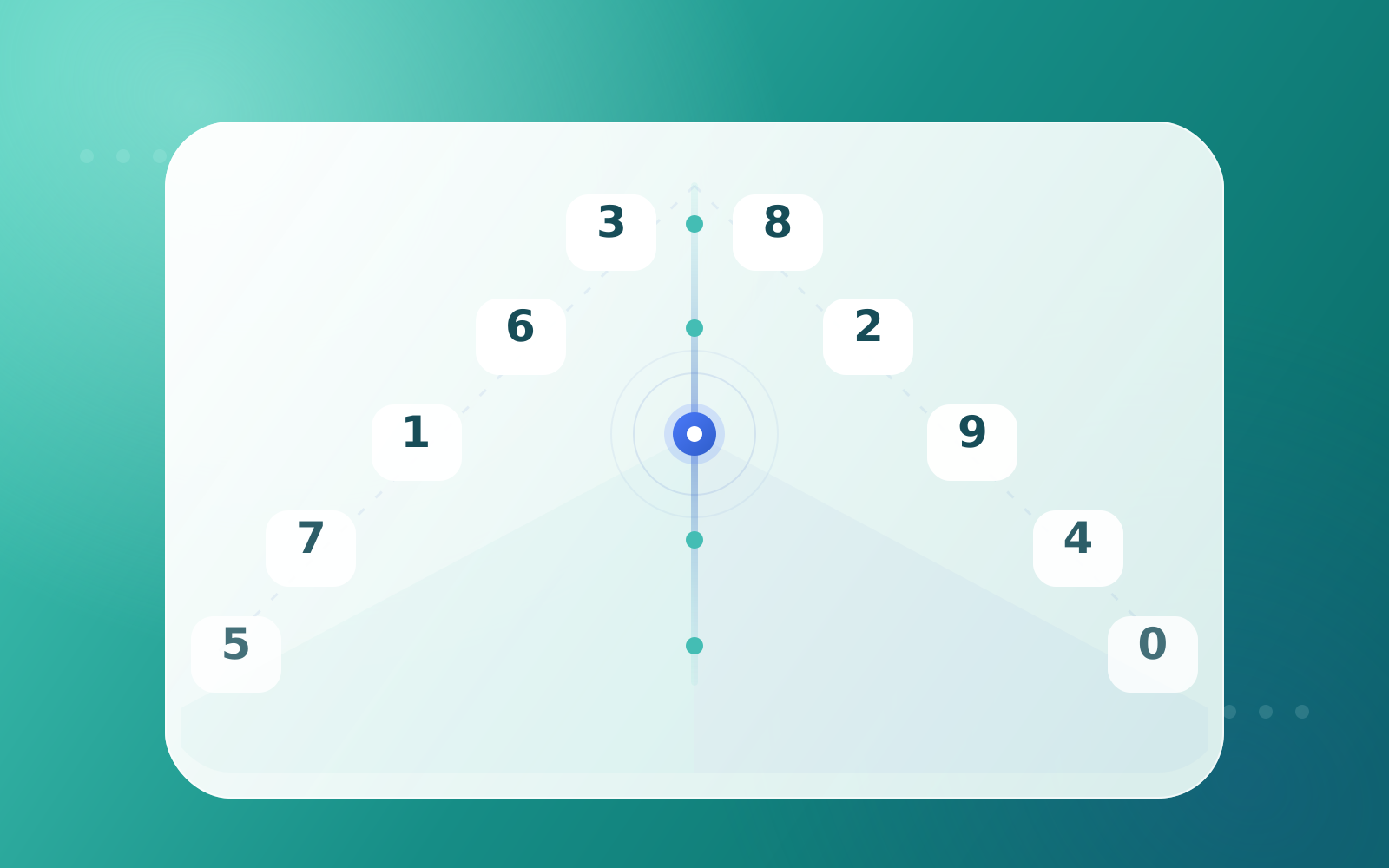
A wedge table is a short exercise in which a child keeps their gaze near a central marker while trying to recognize symbols placed to the left and right. The task engages central fixation, the distribution of visual attention, and the perception of objects away from the point of fixation.
Keep your eyes on the central marker and try to name the symbols at the edges without looking directly at each one.
What Is a Wedge Table?
A wedge table consists of a central line or marker with two columns of symbols on either side. The symbols start close to the center, and the distance between them gradually increases. This widening layout gives the exercise its wedge-like shape.
The child works down the table, keeping their gaze in the center while trying to identify the symbols on the left and right. The exercise can use:
- numbers;
- letters;
- geometric shapes;
- simple pictures;
- short syllables, letter strings, or words at more advanced levels.
Speed-reading programs often describe this as peripheral-vision training or an exercise that “expands the visual field.” Those phrases are easy to understand, but they need clarification. A wedge table does not change the anatomical boundaries of a child’s visual field. It creates a task in which attention must be distributed beyond the central point while the eyes remain near a central fixation marker.
Why Might a Child Struggle to Take In a Line of Text?
A beginning reader uses considerable mental effort to decode print. The child must recognize letters, retrieve the sounds they represent, blend those sounds, identify the word, and keep its meaning in working memory. Until these processes become sufficiently automatic, the eyes tend to stop more often and the area of useful information available during each stop remains relatively small.
You may notice that the child:
- reads letter by letter or in very small parts;
- makes many stops within a word;
- goes back to text they have already read;
- has difficulty moving from the end of one line to the beginning of the next;
- loses the meaning of a long sentence;
- starts guessing words instead of reading them accurately;
- tires quickly.
None of these signs alone proves that a child has a “narrow visual field.” The same behavior can have different causes. A child may look back, for example, because they did not understand a word or lost the meaning of the sentence—not simply because of the way their eyes moved.
How Do the Eyes Move During Reading?
During normal reading, the eyes do not glide smoothly along a line. They alternate between short pauses called fixations and rapid movements between them called saccades.
The visual system gathers most of the detailed information about letters and words during a fixation. The sharpest part of vision is at the center of gaze, in the foveal region. Information near it comes from the parafoveal region. Details are less distinct there, but a reader may notice the length of the next word and obtain some information about its letters.
Sometimes the eyes return to an earlier part of the text. These backward movements are called regressions. They are not always errors: a reader may look back to check a difficult word, reconnect two parts of a sentence, or clarify meaning.
As children become more proficient readers, their fixations tend to become shorter and less frequent, while their forward eye movements become longer. Research also shows, however, that eye movements are closely related to how efficiently a child recognizes words and processes language. An unusual gaze pattern may therefore be a result of difficult reading rather than its sole cause.
Research involving Russian-speaking schoolchildren illustrates this development. In a study by the Russian Academy of Education’s Institute of Developmental Physiology, average fixation duration among fourth graders was approximately half that of first graders, while forward saccades were about 1.5 times longer on average. A 2026 study of Russian-speaking first graders found that greater reading fluency was associated with longer saccades and landing the gaze closer to the center of the next word. The authors concluded that efficient control of eye movements develops together with reading experience rather than simply maturing on its own.
What Is the Perceptual Span in Reading?
Researchers use the terms perceptual span and perceptual window for the area from which a reader can obtain useful information during a single fixation.
The perceptual span is not the same as the entire visual field. A person may notice movement far to the side without being able to identify small letters there with equal precision. Reading requires more than detecting that something is present: the reader must recognize it accurately enough.
The size of the useful area depends on several factors:
- age and reading experience;
- the automaticity of word recognition;
- text difficulty;
- letter size and spacing;
- language and writing direction;
- the current task and the reader’s attentional state.
In one Russian study of text reading, the estimated perceptual span was about 3.9 characters for first graders and 6.7 characters for fourth graders. In a moving-window study, Finnish children aged eight processed approximately five characters to the right of fixation, ten-year-olds about seven, and twelve-year-olds and adults about nine.
These figures should not be treated as age-based norms or compared directly across languages: the studies used different methods and texts. They demonstrate a broader principle—the area of useful information changes as reading develops and depends partly on how many resources the child needs to recognize the word currently being viewed.
A meta-analysis of studies involving children and adolescents found a substantial association between visuospatial attention and reading development. Critical reviews, however, note that findings are mixed: different visual tasks do not measure exactly the same ability, and the most consistent relationships with reading tend to appear in tasks that use letters and numbers. It would therefore be inaccurate to treat every peripheral-perception exercise as a proven way to improve reading.
What Does a Wedge Table Exercise Practice?
Maintaining Central Fixation
The child tries not to look directly at every symbol on the sides. This requires controlling the direction of gaze and returning to the center after an accidental eye movement.
Distributing Visual Attention
Attention must be allocated not only to the center but also to two objects on either side. The task becomes gradually more challenging as the table widens.
Recognizing Symbols Away from the Center
The child practices noticing and distinguishing familiar symbols that appear away from the point of fixation. It is best to begin with simple, well-known items.
Maintaining Visual and Attentional Stability
To complete several rows, the child must remember the rule, avoid scanning the entire display at random, and refrain from guessing.
Coordinating Attention and a Spoken Response
If the child names the left and right symbols aloud, they must hold both items in mind and report them in the required order.
A wedge table does not directly teach phonemic analysis, blending, vocabulary, or text comprehension. It is a separate visual-attention exercise.
How the LARNES “Wedge Table” Trainer Works
A central marker appears on the screen, with symbols placed on both sides. The child keeps their gaze near the center and identifies the items at the edges. The distance between them increases from one row or round to the next.
The digital format makes it possible to:
- vary the sequence of symbols;
- increase the distance from the center gradually;
- choose material the child already understands;
- adjust the presentation pace;
- start a new round without memorizing a fixed table;
- record response accuracy.
The main goal is not to finish the table as quickly as possible. It is to maintain central fixation and identify the symbols accurately. A child who shifts their gaze from one side to the other may give the correct answer, but they are completing a different task.
What Age Is the Exercise Suitable For?
A child’s readiness matters more than a precise age. The exercise may be suitable when the child:
- confidently recognizes the numbers, letters, or pictures used;
- understands a short instruction;
- can stay with a task for one or two minutes;
- can see the on-screen symbols clearly and without strain;
- can report what they saw.
Wedge tables are generally used with school-age children who have begun to read. A preschooler can try a simplified version with large shapes or familiar pictures, but the result should not be interpreted as a prediction of future reading speed.
If a child still struggles to recognize letters, it is more useful to make letter recognition secure first. When every symbol requires lengthy recall, the memory load obscures the exercise’s main attentional demand.
The trainer itself is multilingual. Numbers, shapes, and pictures are language-neutral, while letters and written items can be selected for the child’s language and alphabet.
How to Explain the Task to a Child
Keep the instruction short:
Look at the dot in the center. Try not to move your eyes toward the edges. Notice which symbol is on the left and which is on the right, then name them in order.
Demonstrate one example before starting. Ask the child to look at the central marker, and name the two side symbols together. Then let the child try the narrowest part of the table independently.
Do not expect them to identify the most distant symbols immediately. The child should first learn the strategy at an easy level: the gaze stays near the center while attention is distributed to both sides.
How to Do the Exercise Correctly
- Place the device on a stable surface directly in front of the child.
- Choose a comfortable viewing distance at which all symbols are clear and the child does not lean toward the screen.
- Ask the child to look at the central marker.
- Begin with nearby symbols that are easy to tell apart.
- Have the child name the left and right items in the same order each time.
- Continue only after an accurate response.
- If the child makes an error, return to the previous, narrower level.
The child’s head should remain in a natural, comfortable position. Do not hold it still or tell the child not to blink. The important points are not to turn the head toward the symbols and not to look directly at each edge.
An adult can observe the child’s eyes from the side. Avoid turning the activity into a constant inspection, however, because excessive tension makes concentration harder.
How to Increase the Difficulty Gradually
Change one parameter at a time.
| Level | Material | Position | Task |
|---|---|---|---|
| Beginner | Large, high-contrast shapes | Close to the center | Name the symbol on the left and the symbol on the right |
| Easy | Familiar numbers or letters | Slightly wider spacing | Keep the gaze in the center for several rows |
| Intermediate | Visually similar symbols | Gradually widening spacing | Distinguish the symbols and report them in the correct order |
| Difficult | Syllables or short letter strings | Wide wedge | Read the items without looking directly at them |
| Advanced | Short words | Varying distance and pace | Maintain accuracy as the material changes |
Do not make the symbols smaller, increase the distance, and speed up the presentation at the same time. If all three change together, it is impossible to tell what caused an error.
For children who confuse visually similar letters, begin with pairs that look clearly different. Similar pairs in the Latin alphabet—such as b–d, p–q, or m–n—can be introduced later. In another language, use contrasts from the relevant alphabet rather than copying the English examples.
How Long Should a Child Practice?
A wedge table works best as a brief warm-up. One or two minutes of focused practice is often enough. Including the explanation and a second round, the activity may take three to five minutes.
It is better to stop early than continue after responses become random. End the exercise if the child:
- repeatedly looks toward the edges;
- guesses the symbols;
- leans increasingly close to the screen;
- reports eye pain, double vision, headache, or nausea;
- loses track of the instruction or becomes frustrated.
The exercise can be used several times a week or as a short activity before reading a text. Increasing the duration every day does not guarantee faster progress.
What If the Child Moves Their Eyes?
Moving the eyes does not mean that the child is lazy or not trying. The symbols may be too far apart, too small, or not yet familiar enough.
Make the task easier:
- reduce the distance between the symbols;
- increase their size;
- use only two symbols that are easy to distinguish;
- allow the child a few seconds to look calmly over the display;
- show the fixation point again.
If the child can answer only by looking directly at the side symbols, the current level is too difficult. Correct performance at an easier level is more useful than formally completing the entire table.
How to Assess Performance
Consider the quality of the child’s performance, not just speed:
- how many pairs were identified correctly;
- at what distance consistent errors begin;
- whether the child can maintain central fixation;
- how often the display must be repeated;
- whether performance remains stable across several short rounds;
- whether strain or fatigue appears.
Compare the same child’s results on the same device, with a similar symbol size and viewing distance. If the table is larger today or the child has moved closer to the tablet, the new score cannot be compared directly with the earlier one.
Progress within the trainer shows that the child is learning this particular task. It does not yet prove that the child reads ordinary text faster or understands it better. Transfer should be checked separately by having the child read appropriately challenging sentences and stories and answer questions about them.
Will Wedge Tables Increase Reading Speed?
Reading research shows that more proficient readers generally obtain more useful information around the point of fixation, stop less often, and recognize words more quickly. Meta-analytic evidence also shows an association between visuospatial attention and reading. An association, however, does not prove that practicing peripheral perception will automatically increase reading speed.
There is not enough research directly testing wedge tables with children in well-controlled studies. The scientific literature includes research on broader eye-movement and visual-attention training programs, but those findings cannot automatically be attributed to one specific trainer. It would therefore be misleading to promise that a wedge table will:
- expand the visual field by a particular number of degrees;
- teach a child to see an entire line in a single glance;
- multiply reading speed;
- eliminate backward eye movements;
- improve comprehension on its own.
A major scientific review of speed-reading methods describes a trade-off between speed and accurate comprehension. Trying to read far beyond one’s usual rate often becomes skimming and leads to the loss of some content.
The goal for a child should therefore be to read more accurately and fluently while understanding the text—not simply to read as fast as possible. A wedge table can be a supplementary part of practice, but the core of fluency development is work with letters, words, and connected text.
Why Might a Child Read Slowly?
Before trying to increase the child’s visual span, identify where the main difficulty occurs.
The Child Takes a Long Time to Decode Letters and Words
Priorities should include secure letter–sound correspondences, blending sounds, reading short words, and gradually developing automatic recognition of common words.
The Child Reads Accurately but Very Slowly
Useful activities include rereading short, appropriately challenging texts, reading together with an adult, practicing meaningful phrases, and gradually building automaticity.
The Child Reads Quickly but Does Not Understand the Text
Do not increase the pace. Discuss word meanings, ask questions about the content, reconstruct the sequence of events, and help the child notice connections between ideas.
The Child Loses Their Place
Check the text layout, font size, line spacing, fatigue, and comprehension. A reading guide or a ruler under the current line sometimes helps. If the problem is persistent, discuss it with an appropriate professional.
The Child Guesses Words
Return the focus to accurate reading. The child needs to attend to all the meaningful parts of a word rather than replace it with another word that has a similar beginning or overall shape.
What Should Wedge Tables Be Combined With?
To support transfer to reading, a child needs to work with real text after the brief warm-up. Before or after the wedge table, you can also use a short Schulte table: the child finds numbers in order and also practices visual search. One useful sequence is:
- one or two minutes with the wedge table;
- reading familiar letter patterns or words;
- reading a short passage of connected text;
- rereading a difficult sentence;
- answering one or two comprehension questions.
Evidence-based early reading guidance emphasizes accurate word recognition, reading connected text, fluency, and comprehension. These priorities are also consistent with official elementary reading curricula that focus on smooth, meaningful reading at an appropriate individual pace.
This means that progress should not be measured only in symbols or words per minute. Accuracy, expression, and comprehension matter too.
Common Mistakes Parents Make
Asking the Child to “See the Whole Line”
Small letters cannot be recognized with equal clarity across the full width of a page during a single fixation. This expectation creates strain and encourages guessing.
Starting With the Widest Level
If the child has not understood the strategy with nearby symbols, a wide table will not speed up learning. Difficulty should increase gradually.
Measuring Only Completion Time
Finishing quickly while moving the eyes or guessing does not demonstrate development of the target skill.
Forbidding Eye Movements During Ordinary Reading
Saccades and fixations are a natural part of reading. Keeping the gaze in the center is a rule for this particular exercise, not the correct way to read a text.
Replacing Reading With the Table
Recognizing numbers at the edges does not teach a child to decode words or understand sentences. Practice with real text is still necessary after the trainer.
Explaining Every Difficulty as “Narrow Vision”
Slow reading can involve language, instruction, vision, and attention. One online exercise cannot identify the cause.
When to Consult a Professional
The trainer is not a diagnostic tool for vision problems, dyslexia, or attention disorders. Consider discussing the situation with a professional if the child regularly:
- loses their place even in large, clearly formatted text;
- reports double or blurred vision, eye pain, or headaches;
- holds a book or screen very close;
- closes one eye or noticeably turns their head;
- omits many letters or words;
- continues to have substantial reading difficulty despite systematic instruction.
An optometrist or ophthalmologist can assess visual acuity and eye health. Reading skills and possible specific learning difficulties can be evaluated by a qualified teacher, reading specialist, speech-language professional, educational psychologist, or another relevant specialist. A wedge table cannot replace such an assessment.
It is important to distinguish vision disorders from dyslexia. A child may have both, so routine vision care is still necessary. Professional medical guidance does not, however, consider vision exercises a treatment for dyslexia. The core difficulties in dyslexia concern the processing of written and spoken language and require evidence-based reading instruction.
How Educators Can Use the Trainer
An educator can use a wedge table as a brief supplementary exercise during a reading lesson or visual-attention activity. Define the objective in advance: maintaining central fixation, identifying symbol pairs, or preserving accuracy as the spacing gradually increases.
Possible formats include:
- an individual warm-up before reading;
- a short station during small-group work;
- a change of activity between two text-based tasks;
- observation of the child’s strategy;
- a one- or two-minute home activity with clear instructions for the parent.
When recording performance, distinguish between different types of errors. A child may:
- fail to keep their gaze in the center;
- see the symbols but reverse their order;
- fail to recognize a particular letter;
- forget the first symbol while naming the second;
- lose focus after several rows.
These are different situations and require different support. Not knowing a letter, for example, cannot be corrected simply by reducing the distance between the symbols.
For educators, the wedge table is particularly useful as an observable task: it shows how the child allocates attention. Conclusions about reading development, however, should be based on several measures, including reading words and connected text with a check for comprehension.
Try the LARNES “Wedge Table” Trainer
Start with the narrowest, simplest level. Ask the child to look at the central marker and calmly name the symbols on the left and right. If their gaze begins moving toward the edges, reduce the difficulty and demonstrate the strategy again.
In LARNES, the “Wedge Table” is part of a system of short educational trainers. It complements activities for letter recognition, attention, word reading, and comprehension, but does not replace them.
Keep your eyes on the central marker and try to name the symbols at the edges without looking directly at each one.
For parents: Get short, purposeful learning activities for your child every day.
For educators: Use LARNES trainers in lessons and assign them to students.
Use the Wedge Table trainer and more than 50 other trainers to support your child's learning or your students' progress.
Sign upFrequently asked questions
Do Wedge Tables Really Expand the Visual Field?
The exercise does not expand the anatomical visual field. It asks the child to notice and recognize symbols farther from the central point while distributing visual attention. Popular teaching materials often call this “expanding the visual field,” but “practicing recognition away from fixation” or “training visual attention across a wider area” is more precise.
Can a Child Learn to See an Entire Line in One Glance?
No. Small letters are not perceived with equal clarity across an entire line. During ordinary reading, the eyes make fixations and saccades. Information beside the fixation point helps a reader prepare for upcoming words, but it does not replace accurate word recognition.
Can the Exercise Help If a Child Loses Their Place?
It may be useful as supplementary attention practice, but losing one’s place can have many causes. Also check the difficulty and layout of the text, fatigue, word-reading accuracy, comprehension, and vision.
Should a Child Be Told Not to Move Their Eyes?
Only as a rule for the current round: the gaze should remain near the central marker. Eye movements are necessary and natural during ordinary reading.
Which Symbols Should Be Used First?
Begin with large, familiar, visually distinct items: simple shapes, numbers, or letters the child recognizes confidently. Add similar-looking symbols and short letter strings only after the basic strategy is secure.
How Can I Tell Whether a Level Is Too Difficult?
The child repeatedly looks toward the edges, guesses, leans closer to the screen, reverses the order, or quickly loses track of the instruction. Reduce the spacing, enlarge the symbols, or return to the previous level.
How Many Minutes Should a Child Practice Each Day?
One or two minutes of the exercise itself is usually enough, with no more than three to five minutes including the explanation. Accuracy and calm performance are more important than duration.
Can a Wedge Table Replace Reading Aloud?
No. To develop fluency, a child needs regular practice with words and connected text, ideally with feedback from an adult. The table should be used only as a supplementary warm-up.
Sources
- Russian federal elementary-school curriculum. “Russian Language, Grades 1–4”, 2025. Requirements for smooth, meaningful reading at an individual pace and the transition to whole-word reading.
- Russian federal elementary-school curriculum. “Literary Reading, Grades 1–4”, 2025. Goals related to reading literacy, reading for meaning, and text comprehension.
- Ivanov V. V., Demidov A. A., Bezrukikh M. M. “Eye-Movement Characteristics in Primary-School Children Reading Texts of Different Difficulty”, in Experimental Psychology in Russia: Traditions and Perspectives, 2010. A study of fixations, saccades, and perceptual span in first and fourth graders. [Article in Russian.]
- Lopukhina A., Eremicheva T., Dragoy O., Parshina O. “Spatial Parameters of Eye-Movement Control During Reading in Russian-Speaking Children”, Journal of Experimental Child Psychology, 2026, vol. 271, article 106564. A study of gaze control in Russian-speaking first graders and its association with reading fluency.
- Rayner K., Schotter E. R., Masson M. E. J., Potter M. C., Treiman R. “So Much to Read, So Little Time: How Do We Read, and Can Speed Reading Help?”, Psychological Science in the Public Interest, 2016. A scientific review of reading, eye movements, and the limitations of speed-reading methods.
- Rayner K., Slattery T. J., Bélanger N. N. “Eye Movements, the Perceptual Span, and Reading Speed”, Psychonomic Bulletin & Review, 2010. A study of the relationship between reading speed and perceptual span.
- Häikiö T., Bertram R., Hyönä J., Niemi P. “Development of the Letter Identity Span in Reading: Evidence from the Eye Movement Moving Window Paradigm”, Journal of Experimental Child Psychology, 2009. Evidence on the development of the letter-identity span in readers of different ages.
- Kim Y.-S. G. et al. “Developmental Trajectories of Eye Movements in Oral and Silent Reading for Beginning Readers: A Longitudinal Investigation”, Scientific Reports, 2022. A longitudinal study of changes in children’s eye movements from first through third grade.
- Gavril L., Roșan A., Szamosközi Ș. “The Role of Visual-Spatial Attention in Reading Development: A Meta-Analysis”, Cognitive Neuropsychology, 2021. A meta-analysis of the association between visuospatial attention and reading development.
- Perry C., Long H. “What Is Going on with Visual Attention in Reading and Dyslexia? A Critical Review of Recent Studies”, Brain Sciences, 2022. A critical review of the role of visual attention in reading and the limitations of the existing research.
- Foorman B. et al. “Foundational Skills to Support Reading for Understanding in Kindergarten Through 3rd Grade”, What Works Clearinghouse, Institute of Education Sciences, 2016; revised 2019. A practice guide covering word recognition, fluency, and reading connected text.
- National Reading Panel. “Teaching Children to Read: Findings and Determinations”, 2000. Findings on developing fluency through guided repeated oral reading with feedback.
- American Academy of Pediatrics et al. “Learning Disabilities, Dyslexia, and Vision”, Pediatrics, 2011. A joint technical report on vision, learning difficulties, and the lack of evidence for vision exercises as a treatment for dyslexia.
- Akhmetova Z. A. “Speed-Reading Classes in Remedial and Developmental Work With Primary-School Children With Attention-Deficit/Hyperactivity Disorder”, 2019. An example of wedge tables in Russian educational practice; this publication is not a separate controlled study of the exercise’s effectiveness.