
How to Teach a Child to Identify the First Sound in a Russian Word
This ability is part of phonemic analysis and plays an important role in learning to read and write Russian. Below, you can try the LARNES “First Sound in a Word” trainer and then learn how this skill develops and how to practice it with a child effectively.
A child may know the letters of the Russian alphabet, recognize them in an alphabet book, and even read individual syllables, yet still struggle with a seemingly simple question: “What sound does the Russian word «мак» (mak, “poppy”) begin with?”
This does not necessarily mean the child is being inattentive. In natural speech, a word is pronounced as one continuous unit, and a child perceives it as a whole. To answer the question, the child has to mentally separate the first sound from the rest of the word, pronounce that sound independently, and then remember which letter represents it.
Listen to the Russian word and choose the letter that represents its first sound.
What Is the First Sound in a Word?
The first sound is the sound we hear at the very beginning of a spoken word. For example:
- «мак» (mak, “poppy”) begins with [м];
- «сок» (sok, “juice”) begins with [с];
- «утка» (utka, “duck”) begins with [у];
- «дом» (dom, “house”) begins with [д].
We hear and pronounce sounds, whereas we see, read, and write letters. Therefore, the first sound in «мак» is [м], and it is represented by the Russian letter М.
For an adult, this connection may seem obvious. A child, however, has to complete several separate steps: listen carefully to the word, isolate its initial sound, identify that sound, and find the corresponding letter. If any one of these steps has not yet developed, the task becomes difficult.
What Do Educators Call This Skill?
The most precise name for this specific action is initial sound identification, or isolating the first sound in a word.
It is part of the broader concept of phonemic analysis: the ability to identify the sounds that make up a word, determine their sequence, and distinguish them from one another.
In Russian speech-language pathology and literacy education, the terms phonemic perception and phonemic analysis are also used. Phonemic perception enables a child to distinguish speech sounds, while phonemic analysis involves consciously isolating those sounds from a word and identifying their position within it.
When a child selects a letter after isolating a sound, another process is added: establishing a sound–letter correspondence, also called a phoneme–grapheme correspondence. The child understands that the sound they hear can be represented by a particular written symbol.
The “First Sound in a Word” trainer therefore works on two related skills:
- isolating the first sound in a spoken Russian word;
- matching that sound to a Russian letter.
Why Can a Child Know Letters but Be Unable to Hear the First Sound?
Knowing the alphabet and analyzing the sounds in a word are not the same skill. A child may remember a letter’s visual shape and name very well but still be unable to analyze spoken language.
The Word Is Perceived as a Whole
When we hear the Russian word «машина» (mashina, “car”), there are no actual pauses between its sounds. Speech is a continuous stream. A child has to learn to direct attention away from the word’s meaning and toward its sound structure.
The Letter Name Interferes with Hearing the Sound
The Russian letter М is called «эм» (em), but in «мак» we hear [м], not the full letter name «эм». If an adult consistently uses only letter names, the child may search for «эм», «эс» (es), or «бэ» (be) inside words and fail to find them.
Some Sounds Are Difficult to Pronounce in Isolation
Russian sounds such as [м], [с], [ф], and [л] can be prolonged slightly: «мммак», «сссок». Plosive consonants such as [п], [б], [т], [д], [к], and [г] cannot be stretched without distortion. They should instead be made more prominent through clear, emphatic pronunciation: «Кот», «Дом».
A Sound and a Letter Do Not Always Correspond One to One
Russian orthography is more complex than a simple “one letter, one sound” system. A single letter may perform different functions, and the number of letters and sounds in a word does not always match. Early exercises should therefore use simple Russian words in which pronunciation and spelling do not create an additional difficulty.
Why Is the Ability to Identify Sounds Important for Reading?
Reading in an alphabetic writing system is based on understanding the connection between spoken and written language. A child needs to grasp the principle that letters and letter combinations represent sounds, and that words are formed from sequences of sounds.
When a child can hear individual sounds, it becomes easier to:
- remember which sound a letter represents;
- blend sounds when reading syllables and words;
- decode an unfamiliar word instead of guessing it from its first letter or an illustration;
- choose letters when writing;
- notice differences between similar-sounding words.
Phonemic awareness and knowledge of sound–letter correspondences are considered important components of early reading instruction. Identifying the first sound, however, is only one of the first steps. To become a proficient reader, a child also needs phonemic blending, the ability to combine letters into syllables, vocabulary, and reading comprehension.
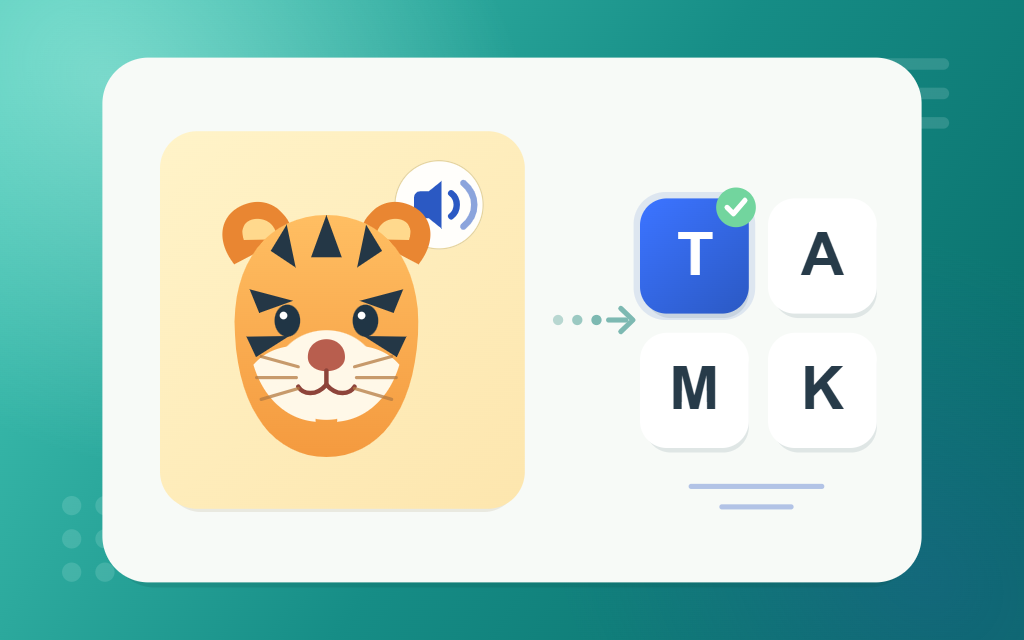
How the “First Sound in a Word” Trainer Works
In each activity, the child:
- hears a Russian word;
- sees an illustration of the named object;
- looks at several Russian letters;
- chooses the letter that represents the first sound.
For example, the child hears «мак» and sees a picture of a poppy. The written word is not shown on the screen, so the child cannot simply look at its spelling and copy the first letter. They need to hear [м] and select М.
The picture helps the child understand which word was spoken and supports attention, but it does not reveal the answer. The main work is performed with the spoken word.
The positions of the letters change from one activity to the next. This encourages the child to search for the correct letter consciously instead of memorizing the location of the correct button.
What Does This Activity Develop?
Initial Sound Identification
The child learns to focus on the sound structure of a word and separate the first sound from the remaining sounds.
Phonemic Perception
To answer correctly, the child has to recognize the sound they heard and distinguish it from other speech sounds.
Sound–Letter Correspondence
The child matches a sound to the visual form of a Russian letter. This gradually helps them understand the alphabetic principle underlying reading.
Auditory Attention
The child needs to listen to the entire word, hold it in memory, and avoid choosing a letter merely because it looks attractive or appears in a familiar position.
Visual Discrimination of Letters
After analyzing the sound, the child searches for the correct symbol among several options. This part of the activity requires them to recognize and distinguish letters.
At What Age Can a Child Begin?
It is better to consider not only a child’s age but also their readiness. The activity is suitable when a child:
- understands the names of the pictured objects;
- can distinguish the target sounds in speech;
- is familiar with at least a few Russian letters;
- can follow a short instruction;
- can stay focused for several minutes.
Focused work on the sound structure of words usually begins during the later preschool years and continues throughout early literacy instruction. Some children can complete simple tasks earlier, while others need more guided practice with an adult.
If a child does not yet know letters, begin with sound-only games: ask them to say the first sound, find pictures whose names begin with the same sound, or sort objects into “sound houses.” Add letter selection only after the child has been introduced to the corresponding written symbol.
How to Explain the Activity to a Child
The instruction should be short and remain the same in every round:
Listen to the word. What sound do you hear first? Find the letter that represents it.
Before the child begins practicing independently, work through two or three examples together.
Say: “Listen: «мммак». At the beginning, you can hear [м]. The sound [м] is represented by the letter М.” Then offer a similar Russian word, such as «мммост» (most, “bridge”) or «мммуха» (mukha, “fly”), and ask the child to identify the first sound independently.
It is important to pronounce the sound [м], not the letter name «эм». Otherwise, the child hears one unit but is expected to search for another.
If the first sound can be prolonged, stretch it slightly while keeping the word intact: «сссок», «фффлаг», «шшшар». Do not divide a word into artificial parts such as «сэ-ок».
With plosive consonants, emphasize the sound clearly without adding an extra vowel: [к], not «кэ»; [т], not «тэ».
How to Progress from Easier to More Difficult Words
The material should become more challenging gradually.
| Level | Types of Russian Words | Examples |
|---|---|---|
| Beginner | A stressed vowel at the beginning | аист, осы, утка, иней, эхо |
| Easy | A continuant hard consonant with no consonant cluster | мак, нос, сок, лук, шар |
| Next | A plosive consonant | кот, дом, бак, ток, гусь |
| More difficult | A soft consonant or similar sounds | мяч, лес, кит, зима, вилка |
| Advanced | A consonant cluster | стол, кран, флаг, слон |
At the first levels, the buttons should contain Russian letters the child already knows. Distractors should initially look and sound clearly different from the correct answer. Later, acoustically similar pairs can be introduced: [с]–[з], [п]–[б], [т]–[д], and [ш]–[ж].
An overly difficult set does not develop the skill more quickly. If a child is still unsure how to identify [м], presenting several similar sounds at once turns the activity into guessing.
Why You Should Not Begin with the Russian Word «енот»
In «енот» (yenot, “raccoon”), the first letter is Е, but the first sound is [й’]. In the standard Russian school model, the letter Е at the beginning of a word represents two sounds: [й’] and [э]. If a child is asked to identify the first sound but Е is treated as the correct answer, the rule becomes contradictory.
For the same reason, these Russian words are best avoided at the beginner level:
- «ёж» (yozh, “hedgehog”);
- «юла» (yula, “spinning top”);
- «яблоко» (yabloko, “apple”);
- «ель» (yel’, “spruce”).
The Russian letters Е, Ё, Ю, and Я require a separate explanation. They can be introduced later, once the child understands the distinction between a sound and a letter and knows that one letter can sometimes represent two sounds.
During the earliest stages, it is also better to avoid Russian words whose spelling differs noticeably from their pronunciation, as well as words with difficult consonant clusters.
What Should You Do If the Child Answers Incorrectly?
Do not give the correct letter immediately. Go back one step: to the sound of the word.
- Repeat the word at a natural pace.
- Say it again, emphasizing the first sound.
- Ask the child to repeat the word in the same way.
- Ask which sound they heard at the beginning.
- Only then ask them to choose the letter.
This helps the child carry out the process rather than merely supplying them with the answer.
If the child selects the correct letter only after receiving a prompt, temporarily reduce the number of options or return to easier words. After several successful examples, gradually remove the prompt.
Should the Child Say the Answer Aloud?
It is helpful to occasionally ask the child to name the sound they identified: “What sound did you hear?” This allows the adult to see whether the child actually performed the phonemic analysis or simply guessed the letter.
The child does not need to say the answer aloud in every activity. If the practice session is short and the child answers confidently, they can simply select the letter on the screen. During guided work with an educator, an oral answer provides more information about the child’s reasoning.
Accept the sound as it is pronounced in the word. For example, the first sound in «мяч» (myach, “ball”) is the soft, or palatalized, consonant [м’], not the hard [м]. Both sounds are represented by the Russian letter М. The trainer checks the selected letter, so the distinction between hard and soft consonants is best discussed separately with an educator or another adult. In Russian phonetic notation, the mark [’] indicates that a consonant is soft.
How Long Should a Practice Session Last?
A few minutes is enough for one session. It is better to complete a small set of activities attentively than to continue after the child becomes tired and starts tapping at random.
Speed is not the objective at the beginner stage. The child needs time to hear the word, repeat it internally, isolate the sound, and find the letter.
End the session or make the activity easier if the child:
- stops listening to the word until the end;
- chooses letters at random;
- continually waits for a prompt;
- becomes visibly frustrated;
- no longer understands the rule.
Regular short practice is more useful than infrequent, lengthy sessions. The trainer can be used several times a week or included in a daily five-minute program alongside other reading activities.
How to Evaluate the Results
In an online trainer, it is useful to track:
- the percentage of correct answers;
- the number of correct answers on the second attempt;
- whether the word had to be played again;
- the groups of sounds that cause errors;
- the consistency of results across several short rounds.
During the first sessions, accuracy and independence matter more than speed. A rapid random choice does not show that a child has learned to analyze a word.
Compare the child’s results with their own previous performance on activities at the same level rather than with other children. The difficulty can change substantially depending on the type of initial sound, the number of letters shown, and the similarity of the distractors.
One unsuccessful round cannot be used to assess phonemic perception or school readiness. To form a professional opinion, a speech-language pathologist uses several tasks and interprets them together with the child’s broader speech and language profile.
Will This Activity Help a Child Learn to Read?
The trainer develops one specific element of reading readiness: moving from a spoken Russian word to an individual sound and then to its corresponding letter.
This is an important skill, but it does not produce proficient reading on its own. A child also needs to learn to:
- blend sounds into syllables and words;
- read from left to right without guessing;
- recognize words with sufficient speed;
- understand the meanings of the words they read;
- retain the meaning of a sentence and a text.
The “First Sound in a Word” trainer is therefore best used as part of a structured Russian literacy program rather than as the only activity.
Once a child can isolate the first sound, the next step is to connect that sound with a letter. The Find the Letter by Sound trainer is useful for this.
Common Mistakes Parents Make
Asking for the First Letter When the Word Is Only Spoken
A letter belongs to a word’s written form. The child should first identify the initial sound and then choose the letter that represents it.
Naming Consonants «эм», «эс», and «бэ»
When preparing a child to read Russian, it is important to model the consonant sound without adding a vowel: [м], [с], [б]. Otherwise, when blending letters, a child may produce «эм-а» instead of «ма».
Beginning with Е, Ё, Ю, and Я
These Russian letters have special functions and represent two sounds at the beginning of a word. For an initial introduction, it is better to choose unambiguous examples.
Expecting the Child to Identify the Sound Without a Model
When a child is still learning, an adult can pronounce the word with them and use intonation to emphasize its beginning. This is not giving away the answer; it is demonstrating the process.
Using Only One Set of Words
The child may memorize the answers. The words and positions of the letters should change while remaining appropriate for the child’s current level.
Correcting Only the Answer
Saying “That is wrong: tap М” does not teach a child to analyze a word. It is more useful to play the word again and isolate its beginning together.
When to Consult a Speech-Language Pathologist
Making several mistakes in a new activity does not necessarily indicate a disorder. Phonemic analysis develops gradually and requires explanation and practice.
Consider discussing the difficulty with a specialist if the child consistently struggles even with simple Russian words after guided practice, especially if other signs are also present:
- the child frequently confuses similar speech sounds by ear;
- substitutes or omits sounds in speech;
- has difficulty repeating sound sequences;
- cannot determine whether a familiar sound is present in a word;
- experiences pronounced difficulty while learning to read and write.
A speech-language pathologist can assess phonemic perception, speech-sound production, phonemic analysis, and other language processes. The online trainer is not intended for diagnosis.
How Educators Can Use the Trainer
An educator can include “First Sound in a Word” in Russian literacy-readiness lessons, when introducing a new letter, or when consolidating sound–letter correspondences that children have already studied.
It is useful to separate activities by difficulty:
- stressed initial vowels;
- continuant consonants;
- plosive consonants;
- hard and soft consonants;
- acoustically similar pairs;
- words with consonant clusters.
The trainer also helps an educator identify the stage at which an error occurs. A child may fail to hear the sound, identify the sound correctly but be unable to recall the letter, or recognize the letter but confuse it with one of a similar shape. These situations require different types of support.
When working with a group, do not evaluate performance solely by the number of quick answers. It is more informative to ask several children to explain: “What sound did you hear? How did you work it out? Which letter represents it?”
Try the “First Sound in a Word” Trainer
Start a new round, ask the child to listen carefully to the Russian word, and let them choose the letter independently. If the answer is difficult, repeat the word together while emphasizing its beginning.
In LARNES, “First Sound in a Word” is part of a system of short educational trainers. The activities gradually change and complement one another: the child learns to hear sounds in Russian words, recognize Cyrillic letters, blend them, read words, and understand what they have read.
Listen to the Russian word and choose the letter that represents its first sound.
For parents: Receive short, useful activities for your child every day.
For educators: Use LARNES trainers in your lessons and assign them to your students.
Use the First Sound in a Word trainer and more than 50 other trainers to support your child's learning or your students' progress.
Sign upFrequently asked questions
Why Does My Child Know Russian Letters but Cannot Identify the First Sound?
Recognizing a letter is a visual skill, whereas isolating a sound requires analysis of spoken language. These abilities are related, but they do not automatically develop at the same time. A child may need separate practice with spoken Russian words.
Which Is the Correct Question: "First Sound" or "First Letter"?
If the child hears a word and does not see it written, ask about the first sound. You can then ask the child to choose the letter that represents that sound.
Can We Begin with the Russian Word «енот»?
It is not a suitable beginner example. The word's first letter is Е, but its first sound is [й’]. Russian words beginning with Е, Ё, Ю, and Я are best introduced after the functions of these letters have been explained separately.
Does This Activity Develop Phonemic Awareness?
It engages phonemic perception and teaches a child to isolate the first sound in a word. Phonemic development also includes other skills: distinguishing similar sounds, finding a sound in different positions, segmenting a word into all its sounds, and blending sounds into a word.
Should the First Sound Be Stretched?
Prolonging the sound can help isolate [м], [с], [ф], [л], and other continuant sounds. Plosive consonants such as [п], [б], [т], [д], [к], and [г] cannot be stretched; they should be emphasized through clearer, stronger pronunciation.
How Many Letters Should Be Shown on the Screen?
At first, two or three familiar and clearly different letters are enough. As the child develops the skill, the number of options can be increased and acoustically similar sounds can be added.
When Should a Child Be Able to Identify the First Sound?
This skill develops during preparation for literacy instruction and at the beginning of formal schooling. Rather than comparing a child with a fixed age threshold, consider their familiarity with Russian letters, speech and language development, understanding of the instruction, and experience with similar activities.
Sources
- Federal Curriculum for Primary General Education. “Russian Language, Grades 1–4”, 2025. Sections on phonemic analysis, distinguishing sounds from letters, and the functions of the Russian letters Е, Ё, Ю, and Я.
- Kuznetsova, M. I. “Russian Language: Implementing the Requirements of the Federal State Educational Standard for Primary General Education”, 2023. Methodological guidance on phonemic analysis, using intonation to emphasize the first sound, and working with sound models.
- Elkonin, D. B. “Stages in the Formation of the Act of Reading”. A discussion of the role of phonemic analysis and the subsequent representation of an isolated sound by a letter.
- Zhurova, L. E., and Elkonin, D. B. “On the Development of Phonemic Perception in Preschool Children”, 1963. A study of the development of phonemic analysis in preschool children.
- National Reading Panel. “Teaching Children to Read: Findings and Determinations”, 2000. Findings on the role of phonemic awareness and systematic instruction in sound–letter correspondences.
- Foorman, B., et al. “Foundational Skills to Support Reading for Understanding in Kindergarten Through 3rd Grade”, Institute of Education Sciences, 2016. A practice guide on integrating phonemic awareness with knowledge of sound–letter correspondences.
- Castles, A., Rastle, K., and Nation, K. “Ending the Reading Wars: Reading Acquisition From Novice to Expert”, Psychological Science in the Public Interest, 2018. DOI: 10.1177/1529100618772271. A scientific review of reading development, from acquiring the alphabetic principle to fluent reading comprehension.